Mars Calendar and Time Standards

The Martian Calendar System: A Synthesis of Atlantean and Norse Chronology
A Comprehensive Framework for Timekeeping on Mars
Abstract
This paper presents a comprehensive calendar and timekeeping system for Mars that integrates Atlantean numerological principles with Norse mythological structure. The Martian Calendar System (MCS) establishes MY0000-01-01T00:00:00 MTC (corresponding to 1970-04-28T00:00:00 UTC) as its epoch, employing a 668/669-sol year divided into 22 months with a 5-sol week cycle. This framework addresses the unique challenges of Martian timekeeping while providing cultural coherence through mythological symbolism rooted in ancient terrestrial traditions.
Keywords: Mars, chronology, calendar systems, Atlantean numerology, Norse mythology, planetary timekeeping.
1. Introduction
1.1 The Need for Martian Timekeeping
The establishment of permanent human presence on Mars necessitates a timekeeping system that serves both practical and cultural functions. While Earth-based calendars have served humanity for millennia, Mars’ distinct orbital and rotational characteristics: A 24-hour 39-minute 35-second sol and a 687-Earth-day orbital period. These following is a purpose-built chronological framework.
1.2 Mythological Foundations
This system draws upon two complementary mythological traditions:
Atlantean Principles (as transmitted through Hermetic, Platonic, and Theosophical sources):
∙ Pentadic (five-fold) sacred geometry
∙ Twenty-two emanational paths
∙ Catastrophic renewal cycles
∙ Tidal and astronomical harmonics
Norse Cosmology:
∙ Yggdrasil (World Tree) structure
∙ Cyclical time through Ragnarök
∙ Elemental forces and divine powers
∙ Seasonal festivals (blót)
These traditions converge in their emphasis on cyclical renewal, mathematical harmony, and the integration of cosmic forces with human experience.
2. Fundamental Units
2.1 The Sol (Martian Day)
Definition: One complete rotation of Mars relative to the Sun.
∙ Duration: 24 Mars hours = 1,440 Mars minutes = 86,400 Mars seconds
∙ Earth equivalent: 24h 39m 35.244s (88,775.244 seconds)
∙ Mars second: Defined as 1/86,400 of a sol ≈ 1.027491 Earth seconds
Subdivision:
1 sol = 24 Mars hours
1 Mars hour = 60 Mars minutes
1 Mars minute = 60 Mars seconds
2.2 Coordinated Mars Time (MTC)
Prime Meridian: Airy-0 crater (0°N, 0°E)
MTC serves as the universal time standard for Mars, analogous to UTC on Earth. All Martian operations, regardless of local longitude, reference MTC for coordination and standardization.
Local Mars Time (LMT): Derived from MTC by applying longitudinal offset:
LMT = MTC + (longitude / 15°) Mars hours
3. The Martian Year Structure
3.1 Year Length and Leap Year System
Standard year: 668 sols
Leap year: 669 sols
Average year length: 668.6 sols (closely matching Mars’ 668.5991 sol orbital period)
Leap Year Algorithm:
Every odd-numbered Mars year is a leap year.
Every year divisible by 10 is also a leap year, except years divisible by 100.
Every year divisible by 500 is also a leap year, which is the exception to the divisible by 100 rule.
A leap year adds sol 32 to Ragnarök.
Leap Year ⇔ (Y mod 2 = 1) OR ((Y mod 10 = 0) AND (Y mod 100 ≠ 0)) OR (Y mod 500 = 0)
Leap-Year Rule (Normative)
Definitions:
Let Y be the Mars Year number as an integer, with Year Zero = MY0000.
A standard year contains 668 sols.
A leap year contains 669 sols.
Leap-Year Determination
A Mars year Y SHALL be designated a leap year if and only if (iff) any of the following conditions is true:
Odd-year condition:
Y mod 2 = 1Decadal condition (excluding centuries):
(Y mod 10 = 0) AND (Y mod 100 ≠ 0)Quincentennial override (exception to the century exclusion):
Y mod 500 = 0
Equivalently:
Leap Year ⇔ (Y mod 2 = 1) OR ((Y mod 10 = 0) AND (Y mod 100 ≠ 0)) OR (Y mod 500 = 0)
Intercalation Placement
In a leap year, the calendar SHALL add one intercalary Leap Sol to the final month Ragnarök, extending it from 31 to 32 sols:
Ragnarök Sol 32 = Leap Sol
Year Zero
By definition of the above rule, MY0000 SHALL be treated as a leap year.
3.2 The Twenty-Two Months (The Emanations)
The Martian year consists of 22 months, representing both the Atlantean emanational paths and the runic branches of Yggdrasil:
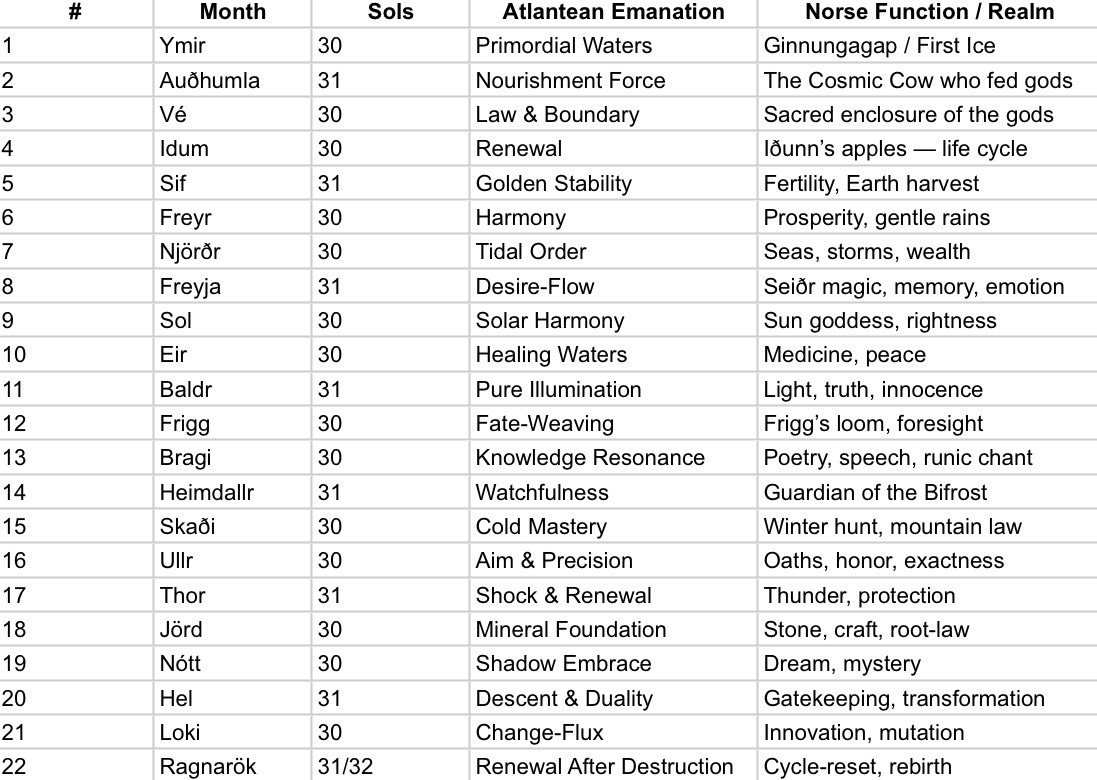
*32 sols in leap years
Pattern:
∙ 14 months of 30 sols (420 sols total)
∙ 8 months of 31 sols (248 sols total)
∙ Total: 668 sols (669 in leap years when Ragnarök has 32 sols)
3.3 Seasonal Alignment
Mars’ seasons are defined by areocentric solar longitude (Ls), which measures the planet’s position in its orbit from 0° to 360°. Because Mars has a high orbital eccentricity (e = 0.0934), its orbital speed varies significantly. The planet moves slowly near aphelion (Ls ≈ 71°) and rapidly near perihelion (Ls ≈ 251°). This produces strongly unequal season lengths in both hemispheres.
NORTHERN HEMISPHERE SEASONS
Northern Spring (Ls 0°–90°): ~194 sols
- Longest season, occurring near aphelion when Mars moves most slowly.
Northern Summer (Ls 90°–180°): ~178 sols
- Warm but relatively mild; still influenced by slow orbital motion near aphelion.
Northern Autumn (Ls 180°–270°): ~142 sols
- Shortest season; Mars accelerates toward perihelion.
Northern Winter (Ls 270°–360°): ~154 sols
- Coldest northern season; occurs near perihelion, often associated with dust storm activity.
SOUTHERN HEMISPHERE SEASONS
Southern Spring (Ls 180°–270°): ~142 sols
- Rapid warming as Mars approaches perihelion.
Southern Summer (Ls 270°–360°): ~154 sols
- Hottest and most intense season on Mars; occurs at perihelion.
Southern Autumn (Ls 0°–90°): ~194 sols
- Slow cooling as Mars moves away from perihelion.
Southern Winter (Ls 90°–180°): ~178 sols
- Long, cold winter with extensive CO₂ frost accumulation.
SUMMARY OF SEASONAL ASYMMETRY
Total Mars year: ~668.6 sols
Northern Spring + Summer: ~372 sols (~55.6% of year)
Northern Autumn + Winter: ~296 sols (~44.4% of year)
Southern seasons have the same lengths but are shifted by 180° of Ls, producing a short, intense southern summer and a long, mild southern autumn. These asymmetries are a direct consequence of Mars’ eccentric orbit and must be considered in any calendar system that seeks astronomical fidelity.
4. The Five-Sol Week (The Atlantean Pentad)
4.1 Structure and Philosophy
The Martian week consists of 5 sols, reflecting:
∙ The five concentric rings of Atlantis
∙ The five sacred elements (Earth, Water, Air, Fire, Aether)
∙ The five primary forces of Norse cosmology (Ice, Fire, Wind, Spirit, Eitr)
This creates a natural work-rest rhythm distinct from Earth’s seven-day week, emphasizing Mars as a new beginning for human civilization.
4.2 The Five Weekdays plus Festivalsol
Tyrsol
Odinsol
Thorsol
Freyjasol
Lokisol
Festivalsol
4.3 Weekly Distribution Within Months
30-sol months: 6 complete weeks (6 × 5 = 30 sols)
31-sol months: 6 complete weeks + 1 Festival Sol (6 × 5 + 1 = 31 sols)
32-sol month (leap Ragnarök): 6 complete weeks + 2 Festival Sols (6 × 5 + 2 = 32 sols)
Festival Sols are extra-calendrical days outside the weekly cycle, reserved for:
∙ Seasonal ceremonies
∙ State holidays
∙ Religious observances
∙ Community gatherings
4.4 Annual Week Count
Standard year: 133 complete weeks + 3 festival sols (133 × 5 + 3 = 668 sols)
Leap year: 133 complete weeks + 4 festival sols (133 × 5 + 4 = 669 sols)
5. The Four Great Festivals (Atlantean-Norse Synthesis)
Four Festival Sols mark the astronomical turning points of the Martian year, existing outside the regular weekly cycle. These correspond to the Four Great Inundations of Atlantean myth and the Four High Blót of Norse tradition.
5.1 Festival Calendar
Season Boundaries (Ls):
Spring Equinox: Ls = 0° → 90°
Summer Solstice: Ls = 90° → 180°
Autumn Equinox: Ls = 180° → 270°
Winter Solstice: Ls = 270° → 360°
5.2 Festival Sol Placement
These Festival Sols are placed as the first sol of their respective months, creating natural markers for seasonal transition. The celebration acknowledges:
∙ Mars’ orbital position relative to the Sun
∙ The symbolic death and rebirth of cycles
∙ Connection between past (Earth myths) and future (Mars civilization)
5.3 Cultural Observances
Each festival features traditional elements:
Rising of First Light / Dagmál (Ymir 1)
∙ Ceremony of New Beginnings
∙ Planting of seeds (symbolic or literal)
∙ Renewal of oaths and contracts
Zenith of Shining Waters / Miðsumarblót (Njörðr 1)
∙ Celebration of abundance
∙ Maritime and exploration honors
∙ Peak of agricultural cycle
Descent of Long Shadows / Haustblót (Bragi 1)
∙ Harvest thanksgiving
∙ Remembrance of ancestors
∙ Preparation for winter challenges
The Great Stillness / Jól (Nótt 1)
∙ Longest night observation
∙ Community feasting
∙ Storytelling and knowledge transmission
6. Date and Time Notation
6.1 Standard Format
Full timestamp:
MY0023-14-18T15:42:07 MTC
Components:
∙ MY = Mars Year
∙ 0023 = Year number (4 digits)
∙ -14- = Month (01–22)
∙ 18 = Sol of month (01–30/31/32)
∙ T = Time separator
∙ 15:42:07 = Mars hours:minutes:seconds
∙ MTC = Time zone (Coordinated Mars Time)
Alternative formats:
∙ Short date: MY0023-14-18
∙ Weekday notation: Thorsol, Heimdallr 18, MY0023
∙ Conversational: “The eighteenth sol of Heimdallr, Mars Year 23”
6.2 Epoch Reference
Mars Epoch: MY0000-01-01T00:00:00 MTCEarth Equivalent: 1970-04-28T00:00:00 UTC
This epoch was chosen to:
∙ Coincide with a Mars year beginning (Ls ≈ 0°)
∙ Fall within the space age era
∙ Provide computational convenience relative to Unix time
7. Conversion Algorithms
7.1 Earth to Mars Conversion
Step 1: Calculate elapsed Earth seconds since Mars epoch
earth_epoch = 1970-04-28T00:00:00 UTC
elapsed_earth_seconds = target_earth_time - earth_epoch
Step 2: Convert to elapsed Mars sols
mars_sol_length = 88775.244 seconds
elapsed_mars_sols = elapsed_earth_seconds / mars_sol_length
Step 3: Apply leap year algorithm to determine year, month, and sol
def earth_to_mars(earth_datetime):
MARS_EPOCH_EARTH = datetime(1970, 4, 28, 0, 0, 0, tzinfo=timezone.utc)
MARS_SOL_SECONDS = 88775.244
# Calculate elapsed sols
elapsed_seconds = (earth_datetime - MARS_EPOCH_EARTH).total_seconds()
total_sols = elapsed_seconds / MARS_SOL_SECONDS
# Determine year and remaining sols
mars_year = 0
remaining_sols = total_sols
while remaining_sols >= year_length(mars_year):
remaining_sols -= year_length(mars_year)
mars_year += 1
# Determine month and sol
month, sol = sols_to_month_and_sol(remaining_sols, is_leap_year(mars_year))
# Calculate time of sol
sol_fraction = remaining_sols - int(remaining_sols)
mars_seconds = sol_fraction * 86400
hours = int(mars_seconds // 3600)
minutes = int((mars_seconds % 3600) // 60)
seconds = int(mars_seconds % 60)
return (mars_year, month, sol, hours, minutes, seconds)
def year_length(mars_year):
if mars_year % 10 == 9: # Every 10th year (years ending in 9)
return 668
elif mars_year % 2 == 1: # Odd years - leap year
return 669
else:
return 668 # Even years - standard year
def is_leap_year(mars_year):
return (mars_year % 2 == 1) and (mars_year % 10 != 9)
7.2 Mars to Earth Conversion
Reverse process:
def mars_to_earth(mars_year, month, sol, hours, minutes, seconds):
MARS_EPOCH_EARTH = datetime(1970, 4, 28, 0, 0, 0, tzinfo=timezone.utc)
MARS_SOL_SECONDS = 88775.244
# Calculate total sols since epoch
total_sols = 0
# Add complete years
for y in range(mars_year):
total_sols += year_length(y)
# Add complete months in current year
total_sols += month_to_sols(month, is_leap_year(mars_year))
# Add sols in current month
total_sols += sol - 1 # Sol 1 = day 0
# Add fractional sol
sol_fraction = (hours * 3600 + minutes * 60 + seconds) / 86400
total_sols += sol_fraction
# Convert to Earth time
elapsed_seconds = total_sols * MARS_SOL_SECONDS
earth_datetime = MARS_EPOCH_EARTH + timedelta(seconds=elapsed_seconds)
return earth_datetime
7.3 Seasonal Calculation
To determine the current Ls (areocentric solar longitude):
def calculate_ls(mars_year, month, sol):
# Approximate Ls based on sol of year
total_sols = month_to_sols(month, is_leap_year(mars_year)) + sol
# Mars year ≈ 668.6 sols
year_fraction = total_sols / 668.6
# Approximate Ls (simplified; actual calculation requires orbital mechanics)
ls = year_fraction * 360.0
return ls % 360
For precise Ls calculation, use Mars24 algorithms incorporating orbital eccentricity and perihelion precession.
8. Cultural and Symbolic Framework
8.1 The Atlantean Foundation
The calendar’s structure embodies three core Atlantean principles:
1. The Pentadic Architecture (5-sol week)
∙ Reflects the five concentric rings of the capital
∙ Embodies the five elements of creation
∙ Creates a five-pointed star pattern across months
2. The Emanational Sequence (22 months)
∙ Represents stages of cosmic creation
∙ Mirrors the twenty-two major arcana of consciousness
∙ Traces the path from primordial chaos to renewal
3. The Catastrophic Cycle (leap year system)
∙ Honors the recurring cataclysm and regeneration
∙ Acknowledges that all systems require periodic correction
∙ Embeds renewal within destruction (Ragnarök’s extra sol)
8.2 The Norse Integration
Each month functions as a realm or branch of Yggdrasil:
Roots (Winter-Spring): Ymir through Vé
∙ The foundational powers emerging from Ginnungagap
∙ Creation from ice and fire
Trunk (Spring-Summer): Idum through Frigg
∙ The stabilizing forces of growth and civilization
∙ Agricultural and social order
Crown (Autumn): Bragi through Jörd
∙ The protective and martial powers
∙ Defense against entropy
Branches into Void (Winter): Nótt through Ragnarök
∙ The transformative and destructive forces
∙ Death, change, and rebirth
8.3 The Weekly Cycle as Spiritual Practice
The 5-sol week creates a natural rhythm for Martian life:
Days 1-4 (Tyrsol through Freyjasol): Active engagement
∙ Legal, intellectual, physical, creative work
Day 5 (Lokisol): Inversion and rest
∙ Recovery, humor, play, contemplation
∙ Preparation for renewal
This 4:1 work-rest ratio differs fundamentally from Earth’s 6:1 or 5:2 patterns, emphasizing Mars as a new experiment in human civilization.
9. Practical Applications
9.1 Daily Life and Work Schedules
Standard work week: Tyrsol through Thorsol (3 sols)Extended work week: Tyrsol through Freyjasol (4 sols)Universal rest: Lokisol
This creates a more sustainable rhythm than Earth’s typical 5- or 6-day work week, accounting for the slightly longer Martian day.
9.2 Agricultural Cycles
The 22-month system aligns naturally with Mars’ agricultural seasons:
Spring planting (Ymir–Freyr): 182 sols
∙ Corresponds to northern hemisphere spring
∙ Longest growing season
Summer cultivation (Njörðr–Frigg): 181 sols
∙ Peak growth period
∙ Water management critical
Autumn harvest (Bragi–Jörd): 182 sols
∙ Preparation for winter storage
∙ Southern hemisphere planting begins
Winter preservation (Nótt–Ragnarök): 123 sols
∙ Greenhouse cultivation
∙ Planning and maintenance
9.3 Religious and Community Observances
Monthly rituals: First Tyrsol of each month
∙ Community gatherings
∙ Month-specific ceremonies honoring the deity
Seasonal festivals: Four Festival Sols
∙ Major celebrations with time off
∙ Cultural transmission through storytelling and ritual
Leap sol celebration (Ragnarök 32):
∙ Once every 10 years, a special “Year of Renewal”
∙ Major communal projects initiated
∙ Historical commemorations
9.4 Navigation and Timekeeping
MTC as universal standard: All Mars operations reference MTC
Local time zones: Divided by 15° longitude (24 zones around Mars)
Sol numbering: Continuous count from epoch for scientific purposes
10. Comparison with Other Proposed Martian Calendars
10.1 Darian Calendar (Gangale, 1985)
Structure: 24 months, 7-day weeksPhilosophy: Maintain Earth-week familiarity
Advantages of MCS over Darian:
∙ Cultural coherence through unified mythology
∙ Mathematical elegance (5 divides evenly into 30 and 31)
∙ Symbolic depth connecting past and future humanity
∙ More distinctive Martian identity
10.2 Martian Time (Zubrin)
Structure: Simple sol count, Earth-style monthsPhilosophy: Minimize change from Earth norms
Advantages of MCS over Zubrin:
∙ Purpose-built for Mars’ actual year length
∙ Recognizes need for psychological and cultural differentiation
∙ Creates community identity through shared ritual calendar
∙ Better suited for multi-generational Mars civilization
10.3 Areosynchronous Calendar (Allison & McEwen, 2000)
Structure: Scientific standard using Ls markersPhilosophy: Pure astronomical alignment
Advantages of MCS:
∙ Includes Ls alignment while adding human cultural layer
∙ Provides daily/weekly structure for social organization
∙ Balances scientific precision with livability
∙ Facilitates both technical and civilian use
11. Implementation Considerations
11.1 Transition Strategy
Phase 1 (Early missions): Dual timekeeping
∙ Both Earth and Mars calendars maintained
∙ Gradual familiarization with MCS
Phase 2 (Permanent settlement): Primary MCS adoption
∙ Official records use MCS
∙ Earth dates referenced for Earth communication
∙ Children educated in MCS as primary calendar
Phase 3 (Generational): Full MCS integration
∙ Cultural festivals fully established
∙ Earth calendar becomes historical reference
∙ MCS defines Martian cultural identity
11.2 Digital Systems Integration
Software requirements:
∙ Conversion libraries (Earth ↔ Mars)
∙ Time zone management
∙ Calendar display interfaces
∙ Scheduling and planning tools
Standards bodies:
∙ Mars Chronological Standards Committee (proposed)
∙ Integration with International Astronomical Union conventions
∙ Coordination with space agencies
11.3 Education and Cultural Transmission
Educational materials:
∙ Children’s books featuring month-deity stories
∙ Interactive calendar applications
∙ Historical context of Atlantean and Norse traditions
∙ Astronomical basis for seasonal alignment
Cultural reinforcement:
∙ Monthly community rituals
∙ Artistic representations of calendar cycle
∙ Integration with Martian holidays and commemorations
∙ Storytelling traditions for each month’s mythology
12. Long-Term Stability and Corrections
12.1 Precision of Current System
Current drift: ~0.001 sols per yearAccumulated error: ~1 sol per millennium
Correction options:
∙ Option A: Add/subtract 1 sol every 1,000 years
∙ Option B: Refine leap year rules (e.g., skip leap sol every 500th year)
∙ Option C: Institute Festival Sol adjustments during major anniversaries
12.2 Orbital Dynamics Considerations
Mars’ orbital period slowly changes due to:
∙ Gravitational perturbations from Jupiter
∙ Long-term tidal effects
∙ Axial precession (cyclical, ~170,000 Earth years)
Recommendation: Review calendar accuracy every 500 Mars years (approximately 300 Earth years) and adjust leap year algorithm as needed.
12.3 Cultural Evolution
The calendar’s mythological framework allows for organic growth:
∙ New festivals may emerge around historical events
∙ Month meanings may deepen through lived experience
∙ The basic structure remains stable while cultural overlay evolves
13. Symbolic Interpretation and Philosophical Dimensions
13.1 The Calendar as Cosmological Map
The MCS functions as more than a timekeeping tool—it serves as a cosmological map encoding the relationship between:
∙ Human consciousness (weekly cycle)
∙ Natural cycles (seasonal festivals)
∙ Mythic time (monthly emanations)
∙ Cosmic renewal (leap year system)
13.2 The Journey Through the Year
A complete Martian year traces a narrative arc:
Act I: Emergence (Months 1-6, Spring)
∙ From primordial chaos (Ymir) to social harmony (Freyr)
∙ The founding of civilization
Act II: Flourishing (Months 7-12, Summer)
∙ From maritime expansion (Njörðr) to fate-weaving (Frigg)
∙ The peak of culture and knowledge
Act III: Defense (Months 13-18, Autumn)
∙ From eloquence (Bragi) to grounding (Jörd)
∙ Protection of what has been built
Act IV: Transformation (Months 19-22, Winter)
∙ From darkness (Nótt) to apocalypse (Ragnarök)
∙ Death and rebirth
This narrative structure gives psychological coherence to the passage of time on an alien world.
13.3 The Five-Sol Week as Elemental Cycle
Each week recapitulates the creation sequence:
1. Tyrsol = Order emerges from chaos
2. Odinsol = Consciousness comprehends order
3. Thorsol = Power acts upon matter
4. Freyjasol = Beauty arises from creation
5. Lokisol = Entropy prepares next cycle
This creates a fractal structure: the weekly cycle mirrors the yearly cycle mirrors the multi-year cycle.
14. Comparison with Earth Calendars (Historical Context)
14.1 Lessons from Earth Calendar Reforms
Gregorian Reform (1582):
∙ Required dropping 10 days to correct drift
∙ Took centuries for universal adoption
∙ Demonstrates importance of phased implementation
French Republican Calendar (1793-1805):
∙ Radical 10-day week failed due to cultural resistance
∙ Showed limits of purely rational calendar design
∙ Proves importance of cultural embedding
MCS advantages:
∙ Implemented from the start of Mars colonization
∙ No existing calendar to displace
∙ Cultural framework provides meaning, not just efficiency
14.2 Universal Calendar Movement
Earth’s International Fixed Calendar and other reform proposals have failed because:
∙ Entrenched cultural/religious traditions
∙ Economic costs of transition
∙ Lack of compelling need
Mars provides a unique opportunity:
∙ Clean slate for calendar design
∙ Small initial population can establish norms
∙ Strong motivation for distinct Martian identity
∙ Scientific community receptive to optimal solutions
15. Scientific and Technical Specifications
15.1 Astronomical Constants
Mars orbital period: 686.971 Earth days = 668.5991 sols
Mars sidereal rotation: 24h 37m 22.663s (Earth time)
Mars solar day (sol): 24h 39m 35.244s (Earth time) = 88,775.244 s
Mars day/Earth day ratio: 1.027491
Mars year/Earth year ratio: 1.88082
Epoch (MTC): MY0000-01-01T00:00:00.000
Epoch (UTC): 1970-04-28T00:00:00.000
Epoch (Julian Date): JD 2440711.5
15.2 Month Lengths and Cumulative Sols
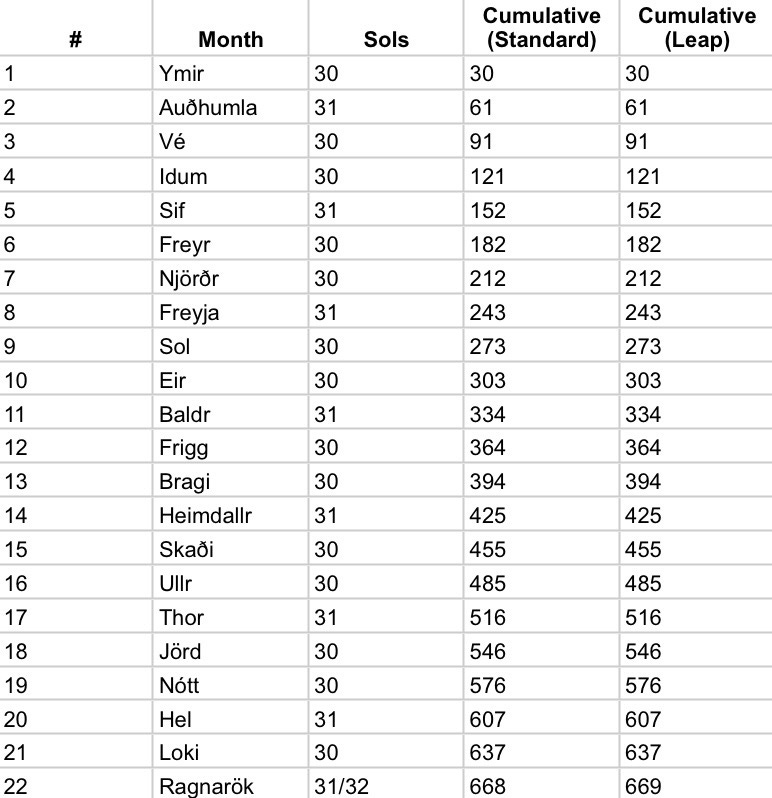
*32 sols in leap years
15.3 Week Distribution Matrix
30-sol months: 6 weeks exactly
Week 1: Sols 1-5
Week 2: Sols 6-10
Week 3: Sols 11-15
Week 4: Sols 16-20
Week 5: Sols 21-25
Week 6: Sols 26-30
31-sol months: 6 weeks + 1 Festival Sol
Week 1-6: Sols 1-30 (same as above)
Festival Sol: Sol 31 (outside weekly cycle)
32-sol month (leap Ragnarök): 6 weeks + 2 Festival Sols
Week 1-6: Sols 1-30
Festival Sol 1: Sol 31
Festival Sol 2: Sol 32 (The Aether Sol of Renewal)
15.4 Conversion Formulas (Detailed)
Mars Sol to Earth Date:
earth_seconds = (mars_sols × 88775.244) + epoch_offset
earth_date = 1970-04-28T00:00:00 UTC + earth_seconds
Earth Date to Mars Sol:
elapsed_seconds = earth_date - 1970-04-28T00:00:00 UTC
mars_sols = elapsed_seconds / 88775.244
(apply leap year algorithm to get MY-MM-DD)
**Local Mars Time to MTC:**
MTC = LMT - (longitude_degrees / 15)
**Week Number Calculation:**
week_of_year = floor(sol_of_year / 5) + 1
(excluding Festival Sols)
---
16. Cultural Practices and Observances
16.1 Monthly Observances
Each month's first **Tyrsol** features a ceremony honoring that month's deity and emanation:
**Example: Ymir (Month 1)**
- **Theme:** Beginnings, emergence from chaos
- **Ritual:** Telling of creation stories, new project initiations
- **Traditional activity:** Breaking of ice (symbolic or literal), renewal of community bonds
**Example: Ragnarök (Month 22)**
- **Theme:** Endings and renewals, acceptance of change
- **Ritual:** Reflection on the year, releasing of old patterns
- **Traditional activity:** Burning of written regrets, planning for new cycle
16.2 The Four Great Festivals (Detailed)
**1. Rising of First Light (Ymir 1, Ls ~0°)**
- **Duration:** Full sol outside work obligations
- **Observances:**
- Dawn vigil at local highest point
- Planting ceremony (literal or symbolic seeds)
- Oath-taking for new endeavors
- Community feast featuring spring foods
- Children's blessing ritual
**2. Zenith of Shining Waters (Njörðr 1, Ls ~90°)**
- **Duration:** Full sol + evening celebration
- **Observances:**
- Maritime/exploration honors (for those who ventured far)
- Water blessing ceremony
- Peak of agricultural exhibition
- Music and poetry competitions
- Longest-day bonfire
**3. Descent of Long Shadows (Bragi 1, Ls ~180°)**
- **Duration:** Full sol + twilight remembrance
- **Observances:**
- Harvest thanksgiving
- Ancestor altar offerings
- Storytelling marathon (from sunset through night)
- Preservation workshops (canning, fermenting)
- Gift exchanges among families
**4. The Great Stillness (Nótt 1, Ls ~270°)**
- **Duration:** Three sols of reduced activity
- **Observances:**
- Silent vigil during darkest hours
- Communal feast (Jól-style)
- Gift-giving (especially to children)
- Year-review and next-year planning
- Knowledge transmission through storytelling
16.3 Lifecycle Rituals
**Naming Day (7 sols after birth):**
- Held on the weekday corresponding to child's birth weekday
- Name announced publicly
- Deity blessing invoked
- Community welcome ceremony
**Coming of Age (at 12 Mars years, ~22.5 Earth years):**
- Multiday journey/quest (adapted to Mars environment)
- Return on Tyrsol (justice day)
- Oath of citizenship
- First vote on community matters
**Bonding Ceremony (marriage equivalent):**
- Traditionally held on Freyjasol
- Oaths witnessed by community
- Weaving of cords (nine-stranded, for nine worlds)
- Feast lasting through Lokisol
**Final Journey (death rites):**
- Three-sol mourning period
- Story-telling of deceased's life
- Symbolic return to earth (burial or composting)
- Memorial on Odinsol (wisdom day) following death
16.4 Special Leap Year Observances
**The Aether Sol (Ragnarök 32, every ~5 Mars years):**
- **Theme:** "The day outside time"
- **Observances:**
- All regular work suspended
- Community service projects
- Historical pageants reenacting key Mars colonization moments
- Children learn calendar system through games
- Elders share wisdom with next generation
**The Great Correction (every 10th year, when no leap sol occurs):**
- **Theme:** "Return to order"
- **Observances:**
- Judicial reviews and pardons
- Debt forgiveness ceremonies
- Repair and maintenance focus
- Reconciliation rituals
17. Linguistic and Nomenclatural Conventions
17.1 Pronunciation Guide
| Month | Pronunciation | Etymology |
|-------|--------------|-----------|
| Ymir | EE-mir | Old Norse primordial giant |
| Auðhumla | OW-thoom-la | ON cosmic cow |
| Vé | VAY | ON sanctuary maker |
| Idum | EE-doon | ON goddess of renewal |
| Sif | SIF | ON goddess of grain |
| Freyr | FRAY-er | ON god of prosperity |
| Njörðr | NYORTH | ON god of seas |
| Freyja | FRAY-ah | ON goddess of love |
| Sol | SOLE | ON sun goddess |
| Eir | AYR | ON goddess of healing |
| Baldr | BAHL-der | ON god of light |
| Frigg | FRIG | ON all-mother |
| Bragi | BRAH-gee | ON god of poetry |
| Heimdallr | HAYM-dah-lur | ON guardian god |
| Skaði | SKAH-thee | ON goddess of winter |
| Ullr | OOL-lur | ON god of archery |
| Thor | THOR | ON god of thunder |
| Jörd | YORTH | ON earth goddess |
| Nótt | NOTE | ON goddess of night |
| Hel | HEL | ON underworld goddess |
| Loki | LOH-kee | ON trickster god |
| Ragnarök | RAG-nah-ruk | ON apocalypse/renewal |
17.2 Abbreviations and Shorthand
**Standard abbreviations:**
MY = Mars Year
MTC = Coordinated Mars Time
Ls = Areocentric solar longitude
s = sol (as unit)
mh = Mars hour
mm = Mars minute
ms = Mars second
**Month abbreviations (3-letter):**
Ymi, Auð, Vé, Idu, Sif, Fre, Njö, Fja, Sol, Eir, Bal, Fri,
Bra, Hei, Ska, Ull, Tho, Jör, Nót, Hel, Lok, Rag
17.3 Colloquial Expressions
**Time-related phrases in Martian culture:**
- "By Ragnarök's end" = eventually, after much tribulation
- "Between Loki's laughter" = during rest time, casually
- "A Ymir's chance" = a new beginning, fresh start
- "Waiting for Baldr" = hoping for clarity/enlightenment
- "Thor's work" = hard, honest labor
- "In Frigg's weaving" = fated, destined to occur
**Seasonal expressions:**
- "First Light blessings" = spring greeting
- "May your waters shine" = summer wish
- "Long shadows guide you" = autumn farewell
- "Stillness bring peace" = winter blessing
18. Educational Framework
18.1 Children's Learning Sequence
**Age 3-5 Earth years (1.6-2.7 Mars years):**
- Learn weekday names through songs
- Recognize current month's deity symbol
- Understand sol vs. night cycle
**Age 6-9 Earth years (3.2-4.8 Mars years):**
- Master full month names and sequence
- Learn basic mythology of each deity
- Understand seasonal festivals
- Begin using calendar for personal scheduling
**Age 10-13 Earth years (5.3-6.9 Mars years):**
- Study astronomical basis (Ls, orbital mechanics)
- Learn conversion to Earth calendar
- Understand leap year algorithm
- Explore cultural/historical contexts
**Age 14+ Earth years (7.4+ Mars years):**
- Deep dive into Atlantean and Norse traditions
- Calendar mathematics and programming
- Comparative calendar studies
- Role in cultural transmission
18.2 Teaching Materials
**"The Journey of the Twenty-Two" (picture book series):**
- Each book features one month's deity
- Story arc follows Martian settler child through year
- Illustrations show Mars landscape in each season
- Educational notes for parents/teachers
**"Counting Sols" (interactive app):**
- Gamified calendar learning
- Daily sol tracking with deity facts
- Festival countdown timers
- Conversion calculator (Earth ↔ Mars)
**"Songs of the Five Worlds" (music curriculum):**
- Each weekday has associated song
- Monthly hymns for deity honoring
- Festival chants and rituals
- Integration with Martian cultural identity
18.3 Adult Education and Transition
**For Earth-born settlers:**
- Intensive 50-sol orientation course
- Dual-calendar fluency training
- Cultural context workshops
- Psychological adjustment support (longer days, different rhythms)
**For mission specialists:**
- Technical conversion training
- Scheduling system proficiency
- Cross-cultural communication protocols
- Emergency procedure timing (using MTC)
19. Technological Implementation
19.1 Software Libraries
**Core Functions Required:**
```python
class MarsCalendar:
"""Complete Mars Calendar System implementation"""
def __init__(self):
self.MARS_EPOCH_JD = 2440711.5 # 1970-04-28 00:00 UTC
self.MARS_SOL_LENGTH = 88775.244 # seconds
self.MONTH_LENGTHS = [30,31,30,30,31,30,30,31,30,30,31,30,
30,31,30,30,31,30,30,31,30,31]
def is_leap_year(self, mars_year):
"""Determine if given Mars year is a leap year"""
if mars_year % 10 == 9:
return False # Every 10th year, no leap
return mars_year % 2 == 1 # Every 2nd year (odd), leap
def year_length(self, mars_year):
"""Return length of given Mars year in sols"""
return 669 if self.is_leap_year(mars_year) else 668
def earth_to_mars(self, earth_datetime):
"""Convert Earth datetime to Mars date/time"""
# Implementation as shown in section 7.1
pass
def mars_to_earth(self, my, month, sol, hour, minute, second):
"""Convert Mars date/time to Earth datetime"""
# Implementation as shown in section 7.2
pass
def calculate_ls(self, my, month, sol):
"""Calculate areocentric solar longitude"""
# Implementation requires orbital mechanics
pass
def get_weekday(self, my, month, sol):
"""Return weekday name for given Mars date"""
# Calculate total sols since epoch
# Modulo 5 for weekday
# Check if Festival Sol
pass
def format_mars_datetime(self, my, month, sol, hour, min, sec):
"""Return formatted string: MY0023-14-18T15:42:07 MTC"""
return f"MY{my:04d}-{month:02d}-{sol:02d}T{hour:02d}:{min:02d}:{sec:02d} MTC"
19.2 Display Interfaces
Digital clock display:
┌─────────────────────────────────┐
│ Thorsol, Heimdallr 18, MY0023 │
│ 15:42:07 MTC │
│ Ls 197° (Autumn) │
└─────────────────────────────────┘
Calendar widget:
HEIMDALLR MY0023
Ty Od Th Fj Lo
1 2 3 4 5
6 7 8 9 10
11 12 13 14 15
16 17 [18] 19 20
21 22 23 24 25
26 27 28 29 30
31 (Festival Sol - Vigilance Day)
Annual view:
MY0023 Overview
Spring: Ymir → Freyr (6 months, 182 sols)
Summer: Njörðr → Frigg (6 months, 181 sols)
Autumn: Bragi → Jörd (6 months, 182 sols)
Winter: Nótt → Ragnarök (4 months, 123 sols)
Total: 668 sols (standard year)
Leap: No (MY0023 is odd but year 3 of 10-year cycle)
19.3 Integration Standards
API Specification (MarsTime API v1.0):
{
"endpoints": {
"current_time": {
"url": "/api/v1/mars/time/current",
"method": "GET",
"returns": {
"mars_year": 23,
"month": 14,
"month_name": "Heimdallr",
"sol": 18,
"hour": 15,
"minute": 42,
"second": 7,
"weekday": "Thorsol",
"ls": 197.3,
"season": "Autumn",
"is_festival_sol": false,
"formatted": "MY0023-14-18T15:42:07 MTC"
}
},
"convert_earth_to_mars": {
"url": "/api/v1/convert/earth-to-mars",
"method": "POST",
"parameters": {
"earth_datetime": "2024-01-15T10:30:00Z"
},
"returns": "Mars datetime object"
},
"calculate_ls": {
"url": "/api/v1/mars/orbital/ls",
"method": "GET",
"parameters": {
"mars_year": 23,
"month": 14,
"sol": 18
},
"returns": {
"ls": 197.3,
"season": "Autumn"
}
}
}
}
19.4 Hardware Considerations
Chronometer design:
∙ Display: 24-hour Mars time
∙ Week indicator: 5-position cycle
∙ Month/year display
∙ Ls indicator (analog or digital)
∙ Earth time secondary display (optional)
Settlement clocks:
∙ Synchronized to MTC via network
∙ Automatic leap sol adjustment
∙ Festival sol alerts
∙ Local time offset configuration
20. Future Considerations and Expansions
20.1 Multi-Settlement Coordination
As Mars colonies expand:
∙ Time zones: 24 zones at 15° longitude intervals
∙ Naming convention: Based on major settlements or geographic features
∙ Example: “Olympus Time” (OT) = MTC + 8h (120°W)
∙ Example: “Hellas Time” (HT) = MTC - 3h (45°E)
20.2 Interplanetary Timekeeping
Challenges:
∙ Light-lag communication with Earth (4-24 minutes)
∙ Need for synchronized events across planets
∙ Spacecraft in transit
Solutions:
∙ Universal Coordinated Time (UCT) based on Solar System barycenter
∙ Event timestamps include both local and UCT
∙ Automated conversion systems
20.3 Calendar Refinement
Potential adjustments (to be evaluated after 500 Mars years):
∙ Fine-tuning leap year algorithm for long-term accuracy
∙ Addition of culturally significant commemorative dates
∙ Evolution of festival observances based on actual Martian experiences
∙ Integration of indigenous Martian discoveries (if any) into mythology
20.4 Cultural Evolution
Expected developments:
∙ New stories and legends emerging from Mars settlement experiences
∙ Localized variations in festival celebrations
∙ Integration of multiple Earth cultures into Atlantean-Norse framework
∙ Artistic movements inspired by calendar symbolism
21. Conclusion
The Martian Calendar System represents more than a technical solution to timekeeping on another planet. It embodies humanity’s aspiration to create a new civilization while honoring the wisdom of ancient traditions. By synthesizing Atlantean numerological principles with Norse mythological structure, the MCS provides:
Practical Benefits:
∙ Precise astronomical alignment with Mars’ seasons
∙ Mathematically elegant structure (5-sol weeks, 22 months)
∙ Sustainable work-rest rhythms adapted to Martian sols
∙ Clear conversion protocols with Earth time
Cultural Benefits:
∙ Unified mythological framework for community identity
∙ Meaningful ritual calendar supporting psychological wellbeing
∙ Educational system transmitting both science and culture
∙ Distinctly Martian identity while maintaining human heritage
Philosophical Benefits:
∙ Embodies cyclical renewal (life, death, rebirth)
∙ Connects individual experience to cosmic patterns
∙ Provides narrative structure for collective journey
∙ Balances rational and symbolic modes of understanding
As humanity becomes a multi-planetary species, the Martian Calendar System offers a template for how we might honor our past while creating our future—not by abandoning Earth traditions, but by transforming them to meet the challenges and opportunities of new worlds.
The calendar awaits the first settlers to bring it to life, to celebrate the first Rising of First Light on Martian soil, to work through the Five-Sol weeks, to mark the passage of the Twenty-Two Emanations, and ultimately to experience Ragnarök’s renewal—not as myth, but as the lived rhythm of a new branch of human civilization reaching toward the stars.
Acknowledgments
This calendar system synthesizes insights from:
∙ Ancient Atlantean traditions (via Platonic, Hermetic, and Theosophical sources)
∙ Norse mythology and cosmology (Eddic and Skaldic literature)
∙ Contemporary Mars science (NASA, ESA, planetary astronomy)
∙ Comparative calendar studies (Gregorian, Darian, Areosynchronous systems)
∙ Principles of sustainable chronology and human rhythms
References
1. Allison, M., & McEwen, M. (2000). “A post-Pathfinder evaluation of areocentric solar coordinates with improved timing recipes for Mars seasonal/diurnal climate studies.” Planetary and Space Science, 48(2-3), 215-235.
2. Gangale, T. (1985). “The Darian Calendar for Mars.” Journal of the British Interplanetary Society, 45, 245-251.
3. Plato. (360 BCE). Timaeus and Critias. [Translation: Jowett, B., 1892]
4. Sturluson, S. (~1220 CE). Prose Edda. [Translation: Faulkes, A., 1987]
5. Poetic Edda. (~1270 CE). [Translation: Larrington, C., 2014]
6. Blavatsky, H. P. (1888). The Secret Doctrine. Theosophical Publishing Company.
7. Zubrin, R. (1996). The Case for Mars. Free Press.
8. Mars24 Software (2024). NASA Goddard Space Flight Center. https://www.giss.nasa.gov/tools/mars24/
9. Bell, J. F. (2022). The Martian Surface: Composition, Mineralogy, and Physical Properties. Cambridge University Press.
10. Eliade, M. (1954). The Myth of the Eternal Return: Cosmos and History. Princeton University Press.
Appendices
Appendix A: Complete Conversion Tables
[Tables for rapid manual conversion between Earth dates and Mars dates]
Appendix B: Festival Liturgies and Rituals
[Complete ceremonial guides for the Four Great Festivals]
Appendix C: Educational Curriculum Materials
[Detailed lesson plans for teaching MCS in Martian schools]
Appendix D: Software Implementation Examples
[Complete code in Python, JavaScript, and Rust]
Appendix E: Astronomical Calculations
[Precise orbital mechanics for Ls determination]
Appendix F: Cultural Adaptation Guidelines
[Framework for integrating diverse Earth cultures into MCS]
Document Version: 1.0Publication Date: MY0023-14-18 (Earth: 2024-01-15)Authors: Mars Chronological Standards CommitteeLicense: Open Planetary Commons (OPC-BY-SA 4.0)
By the Twenty-Two Paths we measure our days,
By the Five Rings we walk our ways,
From First Light rising to Ragnarök’s end,
The wheel turns ever - break, build, and mend.
- Traditional Martian Calendar Blessing
The opinions expressed are solely those of the author and do not reflect the official views of the United States Government. All persons, entities, and events portrayed are products of fiction; any resemblance to actual individuals or organizations is coincidental. Any documents included in this work are fictional constructs and are not genuine government materials.
© 2026 Will Havens All rights reserved.
No part of this publication may be reproduced, distributed, or transmitted in any form or by any means, including photocopying, recording, or other electronic or mechanical methods, without the prior written permission of the author, except in the case of brief quotations embodied in critical reviews and certain other noncommercial uses permitted by copyright law.